
An SEO agency is a company that helps businesses improve their visibility in unpaid search results. Its work usually includes research, technical investigation, page improvements, content, authority development and measurement. The goal is to connect relevant searches with useful pages and a clear path to an enquiry.
That description is accurate, but it still leaves an owner with an important question: what should you actually receive?
At SERP Radius, we want the work to be understandable. You should know what problem is being addressed, why it matters, what changed and how the result will be assessed. A dashboard can support that conversation. It should not replace it.
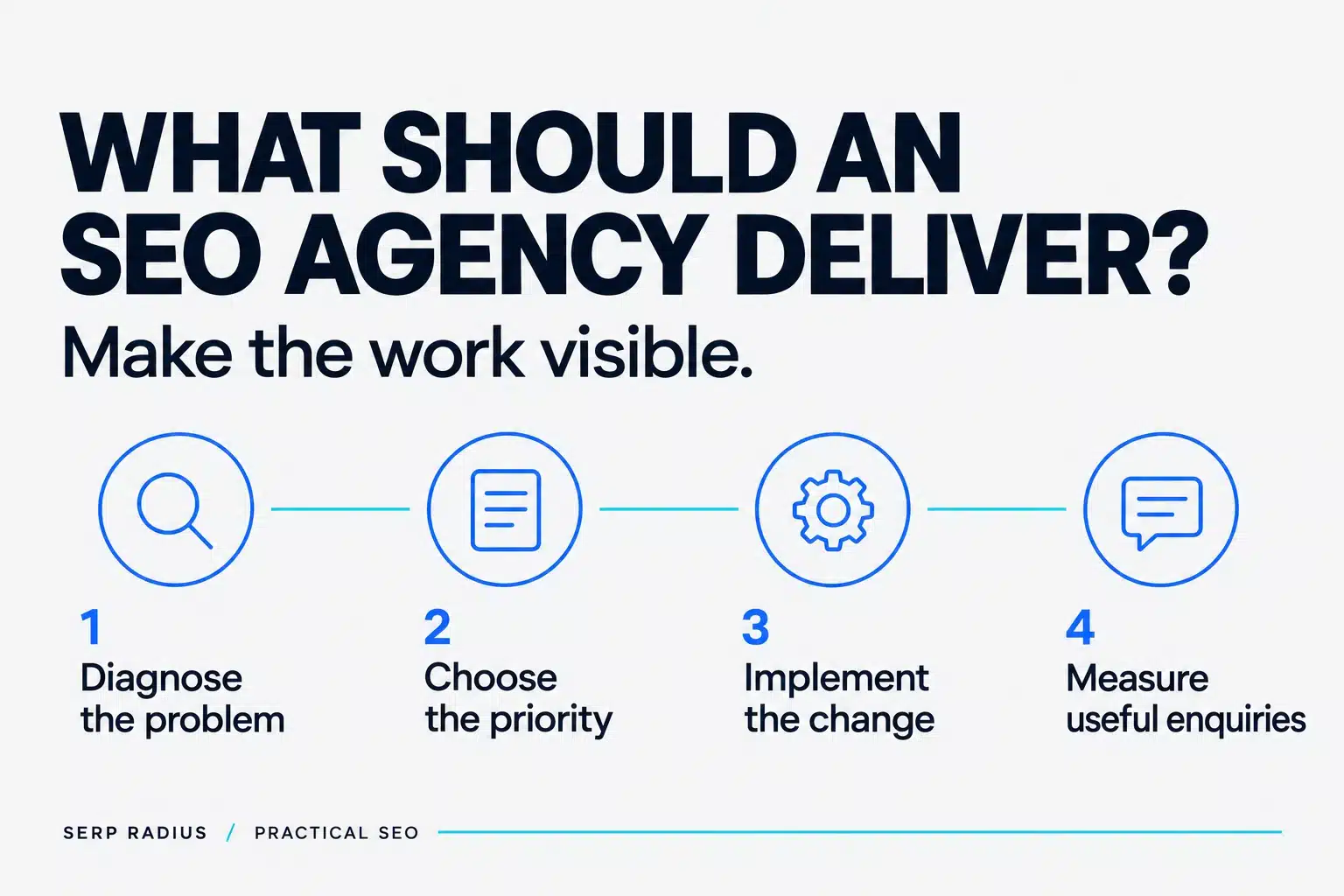
Diagnosis comes before the list of tasks
A useful engagement starts with the business and its current website. Which services matter commercially? Which customers do you want? Where do you operate? What does the existing search data show?
In our own agency research, the instruction was straightforward: establish keywords backed by data before making changes. That order matters. Otherwise, a website can receive new titles, new articles and new links without anybody establishing whether the target searches fit the business.
A good diagnostic deliverable identifies the observation, supporting evidence, likely impact and next action. It also distinguishes a confirmed problem from something that still needs checking.
Our technical SEO audit service is one part of that process, not a substitute for understanding the offer and audience.
Keyword research should produce a page decision
A spreadsheet of phrases is not the final strategy. The agency needs to decide which searches belong on which pages and whether the site has a realistic reason to compete.
An illustrative keyword map could look like this:
| Customer task | Appropriate page | Purpose |
|---|---|---|
| Find a provider for a specific service | Service page | Explain the offer and enable an enquiry |
| Understand the likely investment | Pricing guide | Explain scope and budget trade-offs |
| Diagnose a narrow problem | Supporting article | Help the reader and connect relevant services |
The map should also identify existing pages that can be improved. Creating a second article for a question already answered is not progress simply because it increases the publishing count.
Keyword research and page mapping should make those choices visible.
A redesign is a useful example: the agency should be able to show which URLs need protecting, which redirects were tested and whether enquiries still arrive. Our website redesign SEO checklist sets out the evidence to request before launch.
Technical work should include evidence of the fix
If an agency reports a technical issue, ask which pages are affected and how it was verified. A tool warning alone does not explain the business impact.
For example, an old service URL might lead to the wrong destination after a redesign. The useful record would show the original behaviour, the intended destination, the change made and the follow-up check. An owner does not need to read server configuration to understand that sequence.
Equally, not every report label requires intervention. Some excluded URLs may be intentionally excluded. The agency should explain the decision rather than treating every number in a report as a task to eliminate.
Our published approach to Search Console diagnosis is to corroborate the report before changing the website.
On-page SEO should make the offer clearer
Page optimization includes titles, headings, content structure and internal links. It also asks whether a customer can understand the service and take the next step.
A stronger page explains what is included, who the service suits, what information the business needs and how the engagement works. Relevant examples and proof help the visitor evaluate the offer.
Repeating a city and service phrase through every paragraph does not answer those questions. Neither does replacing ordinary language with technical terminology.
For on-page SEO, the agency should be able to show what became more useful and why the revised page better matches the searcher's task.
Content should support a commercial purpose
Not every article needs to sell directly. It should still serve an audience connected to the business.
A narrow troubleshooting guide can introduce an owner who needs help. A pricing explanation can make a consultation more productive. A service-specific article can answer an objection before somebody asks for a proposal.
The agency should explain that purpose and link the article to a relevant next step. Publishing general marketing advice that attracts students or other agencies may increase traffic without increasing the enquiries your business wants.
Review the topic, intended reader, original contribution and internal links before approving another batch of posts.
Measurement must distinguish interest from an enquiry
A phone-button click and a successful form submission are different events. Verifying enquiry delivery means checking that the submission reaches the intended inbox or lead system. A recorded click alone does not establish that delivery.
An agency report should preserve those distinctions. Useful stages include a relevant visit, an interaction, a received enquiry, a qualified prospect and a won client. Different systems may supply different parts of that picture.
Ask what has actually been tested. If an event fires, does it represent success or merely an attempted action? If leads are increasing, who checked whether they fit the business?
Monthly reporting should explain the next decision
A useful update answers four questions: what changed, what the evidence shows, what remains uncertain and what happens next.
Early work may focus on access, tracking and important commercial pages. Later work may expand useful content or address a competitive gap. The sequence should reflect the site rather than an identical monthly checklist for every client.
See what to expect in the first 90 days for the broader progression. Keep the distinction between activity and outcome: completing work is verifiable immediately; its search impact usually needs more observation.
Red flags worth questioning
Be cautious when reports contain rankings without page context, traffic without enquiry quality or promises that cannot be explained. Ask for the underlying reasoning before accepting another dashboard screenshot.
Also check who owns implementation. Advice that nobody can apply will not improve a website. A proposal should make responsibilities clear, including what the business must supply and what is outside the agreed scope.
For the buying decision itself, use our guide to choosing an SEO agency in Toronto.
Questions business owners ask
Should my agency guarantee rankings?
It should explain the opportunity, work and limitations. It cannot control search results or guarantee a fixed position.
Do I need every SEO service immediately?
No. Priorities should follow the verified constraints, your business goals and the resources available to implement changes.
What should I ask for before agreeing to a proposal?
Ask for the target audience, priority pages, proposed work, implementation responsibilities, measurement approach and exclusions.
Make the work accountable
The useful test is whether you understand the connection between the problem, the work and the business objective.
SERP Radius offers SEO consulting in Toronto for businesses that want those decisions explained. Book a consultation to discuss your website and the work it actually needs.