
Keyword Research and Analysis for Toronto Businesses
Find High-Intent Keywords Your Competitors Miss
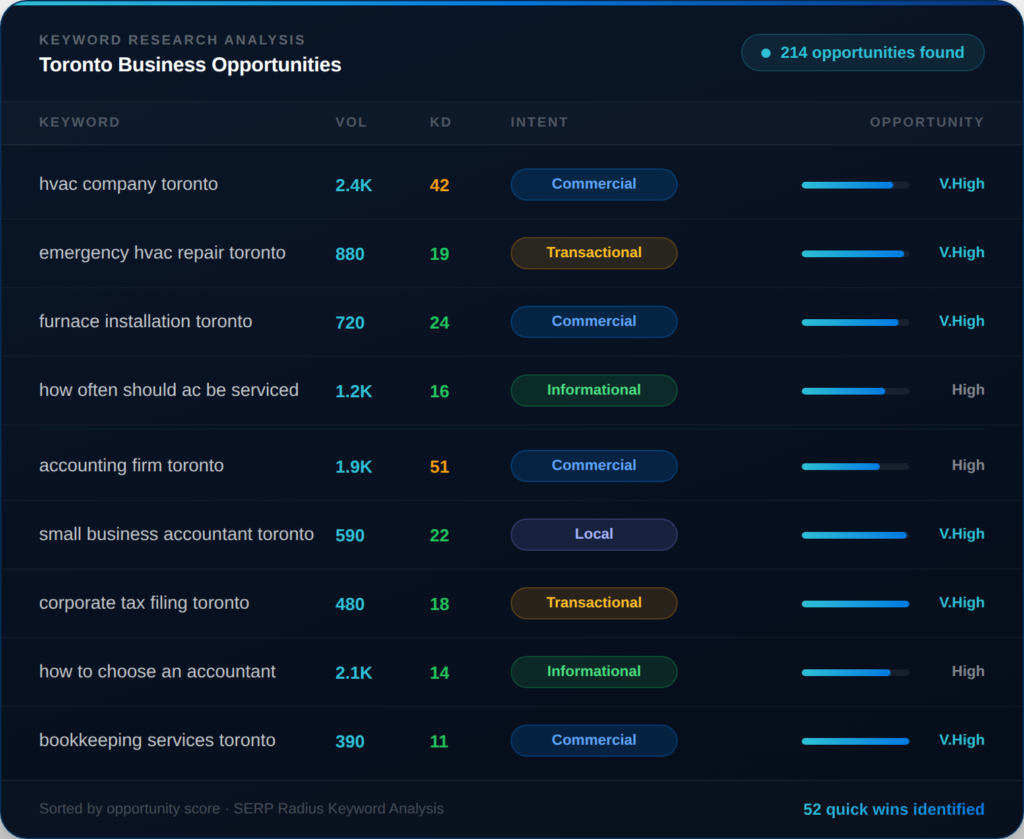
SERP Radius helps Toronto businesses decide which searches to target and which pages to improve. We review your services, existing search performance and competing results to identify relevant opportunities. The research connects keywords with search intent, suitable pages and practical priorities for content and on-page SEO.
Clients We've Worked With






Keyword Research Toronto: The Foundation of SEO Strategy
Keyword research turns search data into decisions about your website. We assess whether a query fits your offer, what the searcher needs and which page can answer that need. The aim is a useful plan for existing pages and content gaps, with priorities based on relevance, demand and the work needed to compete. Read how keyword research connects searches with page decisions.
A lower-volume query can be useful when it closely matches a service you provide. Broad searches can also matter, but search volume alone does not establish commercial value. We consider the likely customer need and the next step your page offers before recommending a target.
Targeting the Right Keywords
Ranking depends on selecting keywords that match search intent and align with your services. Targeting the wrong terms leads to wasted effort and missed opportunities.
Understanding Search Intent
Every keyword reflects a stage in the decision process. Aligning content with intent is critical for turning traffic into leads.
Identifying Low-Competition Opportunities
Specific queries can reveal a close fit with your offer. We examine demand and current results before deciding whether an opportunity is realistic; a low difficulty score alone is not enough.
Mapping Keywords to the Right Pages
Keyword research is only effective when each term is assigned to the correct page. Mapping keywords prevents cannibalization and ensures your site targets multiple search variations effectively.
Search Intent Framework Used in Keyword Research Toronto
Every keyword reflects a specific stage in the search journey. Our SERP Radius Toronto SEO experts focuses on identifying these intent types and mapping them to the right pages to maximize rankings, traffic, and conversions.

Informational Intent (Early-Stage Opportunities)
Informational searches ask how something works or how to solve a problem. We assess whether an existing guide can answer the question and help the reader find the relevant service when needed.
Evaluation Intent (Mid-Funnel Keywords)
Evaluation searches compare providers, costs and approaches. We inspect current results and recommend improvements to the existing page that best answers the buying question.


Transactional Intent (High-Conversion Keywords)
Service and hiring searches can indicate readiness to contact a provider. We assess the wording, competing results and fit with your offer before assigning the query to an existing commercial page.
04
Navigational Intent (Brand and Direct Searches)
Navigational searches look for a particular business or website. We review branded queries separately so they do not inflate the apparent performance of non-brand service targeting.

Our Research Process
Keyword Research Services Toronto That Deliver Actionable SEO Strategy
Keyword research should result in clear, actionable insights that guide every SEO decision. Our keyword research services Toronto focus on identifying high-value opportunities, analyzing competition, and mapping keywords to the right pages so your website can target terms that drive traffic, rankings, and leads.

In-Depth Keyword Discovery
We identify every relevant keyword your audience is searching, including high-volume terms, long-tail opportunities, and untapped variations.
- Short-tail and long-tail keyword identification
- Toronto-specific and geo-modified keywords
- Existing keyword performance analysis
- Related topics and customer questions
Competitor Keyword Gap Analysis
We analyze the keywords your competitors are ranking for and identify opportunities your site is not currently capturing.
Top competitor keyword analysis
Keyword gap identification
Opportunity prioritization based on difficulty
Competitor content and ranking analysis
This reveals the fastest opportunities to close ranking gaps and gain visibility.


Search Intent and SERP Analysis
We evaluate how Google ranks content for each keyword and identify the format required to compete.
- SERP structure analysis
- Content format recommendations
- Featured snippet opportunities
- Ranking feasibility assessment
This ensures your content aligns with what Google is already rewarding.
04
Keyword Difficulty and Opportunity Scoring
We assess each keyword based on competition level and your ability to rank.
- Keyword difficulty analysis
- Domain authority comparison
- Opportunity scoring system
- Quick-win keyword identification
This prioritizes keywords that can generate results within a realistic timeframe.


Turn Keyword Research Into a Page Plan
A useful keyword-to-page plan connects a search with its intent, the existing page that serves it and the change worth making. The following sample is illustrative; it is not a report of client rankings.
- Query cluster
- Service pricing and package inclusions.
- Customer intent
- Compare the likely scope and responsibilities before contacting a provider.
- Existing destination
- The relevant pricing or service-scope page.
- Recommended edit
- Clarify the inclusions, exclusions, implementation responsibilities and quotation process.
- Priority and validation
- Use relevance and existing search evidence to prioritise the edit, then review the page queries and enquiry quality after publication.
Your own plan identifies the primary topic, related searches, recommended headings, internal links and next actions for each priority URL.
Keyword Research Toronto Case Study: Identifying High-Impact Opportunities
A Toronto-based home services company was targeting a limited set of high-competition keywords and generating minimal organic traffic. A structured keyword research Toronto process identified 94 untapped keyword opportunities across service-specific queries, neighbourhood-based searches, and long-tail variations with lower competition. Each keyword was mapped to existing or new pages, with 28 prioritized as quick-win opportunities based on ranking feasibility and search intent. Within 8 weeks, the business began ranking for multiple target terms, resulting in a 194% increase in organic traffic and a significant rise in qualified leads from search.
"We had no idea how many keywords we were missing. The research showed us a completely different strategy — instead of fighting for impossible terms, we started owning the ones our customers actually searched. Rankings came within weeks for the first batch."
— Owner, Toronto HVAC & Plumbing Company
94
Untapped keyword opportunities identified
28
Quick-win keywords ranked within 8 weeks
+194%
Organic traffic growth from new keyword targets
3.4×
Increase in qualified organic leads
Keyword Research Services Toronto: Your Questions Answered
What will I receive from your keyword research service?
You receive prioritised keyword groups mapped to relevant website pages, with recommendations for existing content and any gaps that need attention. The research considers search intent, estimated demand and competing pages. Your proposal confirms the number of services, locations and pages covered.
How do you identify keywords that could bring enquiries rather than just traffic?
We start with the services you sell, the customers you want and the areas you serve. We then examine the searches and competing results to distinguish buying intent from general research. A term such as “emergency plumber Toronto” suggests a different need from “how to fix a dripping tap.” Search volume alone does not determine priority or guarantee enquiries.
Can you improve keyword targeting on my existing pages?
Yes. We review your existing pages and available Google Search Console data before recommending new content. Where a page already matches the search intent, we identify opportunities to improve its targeting, headings, content and internal links. A new page is recommended only when the topic serves a distinct need that existing pages do not adequately address.
Do you research the keywords my competitors rank for?
Yes. We examine the websites appearing for searches relevant to your services, including competitors you identify. We compare their ranking pages with your existing coverage to find missed opportunities. Each opportunity is checked against your actual offer and target market, rather than copying a competitor’s keyword list.
How much do keyword research services cost in Toronto?
Pricing depends on the number of services, locations and topics being researched, the competitor analysis required and the depth of page mapping. SERP Radius confirms the deliverables, fee and delivery date in your proposal. Research and website implementation are scoped separately so you know exactly what is included.
Will you implement the recommendations, or does my team handle them?
SERP Radius can implement the agreed changes or provide a keyword-to-page plan for your writers, marketing team or developer. Your proposal identifies who updates each page and whether content writing or on-page optimisation is included. Research provides direction; improvements depend on putting the recommendations into practice.
Explore Our Other SEO Services
On Page SEO
Technical SEO
Local SEO
Link Building
Keyword Research
SEO Consulting
Build Your SEO Strategy With Keyword Research Toronto Businesses Rely On
If your SEO strategy is not delivering results, the issue often starts with targeting the wrong keywords. Keyword research Toronto provides the foundation for identifying opportunities that drive traffic, rankings, and qualified leads. SERP Radius helps businesses decide which searches and pages deserve attention first. Our B2B manpower SEO case study shows how service-page targeting and supporting information worked together in a Middle East campaign. Read how keyword research connects search intent to page decisions, then contact us to discuss your services and market.
What we review?
- Commercial search intent and keyword-to-page mapping
- Competitor keyword gaps and ranking feasibility
- Local keyword ranking opportunities
- Competitor local SEO analysis
- On-page local signals and schema markup