
Many businesses invest in SEO with the wrong timeline in mind.
Some expect leads in two weeks. Others expect page-one rankings by the end of the month. Many assume SEO behaves like paid ads where traffic starts the moment the campaign goes live.
That is usually where disappointment begins.
SEO is a growth channel built on compounding improvements. Search visibility strengthens when technical issues are resolved, pages become more relevant, authority improves, and Google gains confidence in the site over time.
For businesses hiring a Toronto SEO agency, the first 90 days are less about instant domination and more about building momentum correctly.
The good news is that strong early progress is possible when the campaign starts with the right priorities.
Why the First 90 Days Matter
The opening phase of an SEO campaign often determines whether the next twelve months become productive or frustrating.
When agencies rush into random blog posts, generic backlinks, or vanity keywords, results tend to stall.
When the first 90 days focus on fundamentals, the business usually gains cleaner technical performance, stronger keyword targeting, better tracking, improved local relevance, clearer growth priorities, and more efficient long-term progress.
The first quarter should create leverage, not noise.
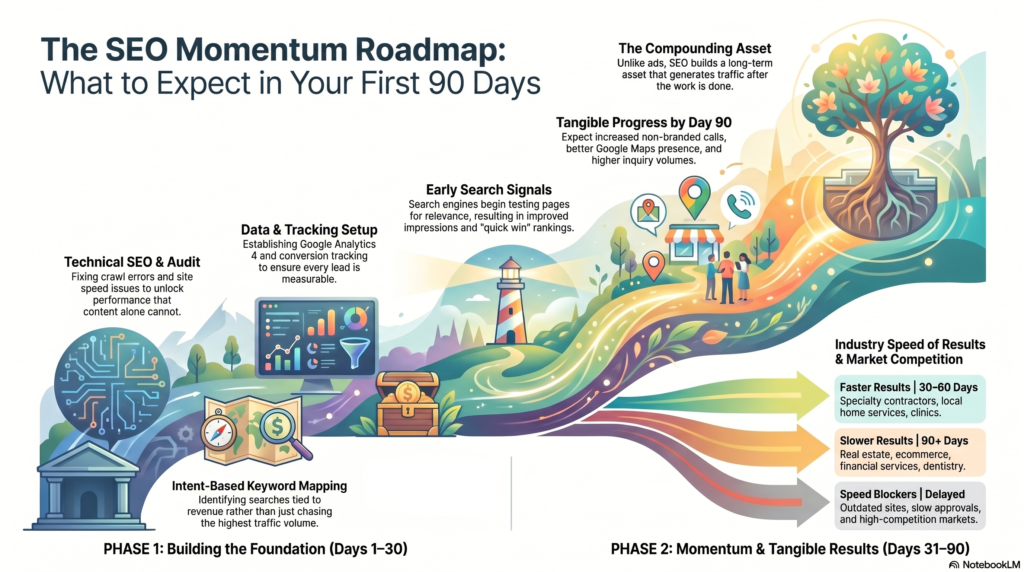
Days 1 to 30: Foundation, Cleanup, and Strategy
The first month is usually where serious work happens behind the scenes.
It may not always look exciting externally, but this stage often determines future results.
Technical SEO Audit
Many sites have hidden issues suppressing growth: crawl inefficiencies, duplicate pages, broken internal links, slow templates, indexing gaps, and mobile usability problems.
Resolving these issues early can unlock performance that content alone would not fix. Businesses with aging websites often benefit from a technical SEO audit before broader growth work begins.
Tracking and Measurement Setup
Without accurate data, decisions become guesswork.
Month one should usually include a Google Analytics 4 review, Google Search Console setup, conversion tracking, call tracking where relevant, and form submission monitoring. If leads increase later, you need to know why.
Keyword and Intent Mapping
Strong SEO does not begin with the highest volume keywords. It begins with identifying searches tied to revenue. Our keyword research process separates informational searches from commercial searches, urgent service searches, local intent searches, and branded opportunities. This is where strategy matters more than raw traffic.
Competitor Review
Toronto search results are crowded in many industries.
A serious campaign should examine who owns page one, why they rank, content depth, backlink strength, review authority, and local presence. This helps set realistic expectations and smarter priorities.
Quick Wins
Month one can also produce early gains through practical fixes such as title tag improvements, better meta descriptions, heading structure cleanup, broken page repairs, and Google Business Profile refinements. These are not magic tricks, but they often create immediate momentum.
Days 30 to 60: Early Signals and Measurable Movement
This is often where the campaign begins to show signs of life.
Not every result will be dramatic, but meaningful indicators usually start appearing.
Pages that were ignored may start entering search results after technical fixes. Sharper titles and descriptions can improve traffic even before rankings move significantly. Google may begin testing your pages for more relevant searches, and lower competition or niche terms often move first.
Businesses prioritizing nearby lead flow often benefit from focused local SEO work during this stage, particularly around Google Business Profile activity and review acquisition.
Days 60 to 90: When Clients Start Feeling Progress
This is often the first stage where SEO becomes tangible.
Depending on industry and competition level, businesses may begin seeing stronger rankings for target terms, calls from non-branded searches, better form enquiry volume, improved Google Maps presence, service pages gaining traction, and stronger conversion rates from page upgrades.
For less competitive niches, growth can accelerate faster. In more aggressive Toronto sectors, this phase may still be the beginning of a longer climb.
What Toronto Businesses Commonly Get Wrong
The biggest mistake is expecting SEO to behave like advertising.
Paid ads can create immediate clicks. SEO builds an asset. That asset can keep generating traffic and leads long after the work that created it. Businesses comparing short-term and long-term channels often ask whether ads can replace SEO entirely. They serve different purposes, and the answer depends on your market and budget, which is why we break it down in detail in our guide on SEO vs Google Ads for Toronto businesses.
Another common mistake is expecting every keyword to rank at once. Search growth is usually uneven. Some pages move early, others take time.
Which Industries See Faster Results?
Not every niche moves at the same speed.
Businesses that often move faster include specialty contractors, local home services in narrower niches, clinics with weak SEO competitors, and businesses with poor competitors already on page one.
Businesses that typically move slower include those in dentistry in central Toronto, real estate, ecommerce categories, and financial services. The more revenue attached to a search term, the more aggressive the competition usually becomes.
What Can Slow Down the First 90 Days?
SEO speed is often limited by execution speed.
Common blockers include outdated websites, slow page speed, thin service pages, delayed approvals, multiple internal decision-makers, unrealistic budgets, previous spam SEO history, no review strategy, and highly competitive markets.
Sometimes the issue is not the campaign. It is the environment around it.
What Clients Should Expect From a Real SEO Agency
The first 90 days should involve more than screenshots of rankings. Understanding what an SEO agency actually does month to month makes it much easier to evaluate whether the work is real.
A serious provider should deliver clear communication, transparent reporting, completed deliverables, strategic priorities, honest commentary, technical progress, content improvements, and direct answers to questions every month.
By day 90, the website should be stronger than it was on day one, with better visibility trends, cleaner tracking data, clearer keyword opportunities, and a roadmap for the next phase. One of the clearest signs of a real campaign is whether you can actually tell if your SEO agency is doing real work or just sending reports.
Good SEO should feel organized, not mysterious.
Businesses evaluating providers should also understand what a Toronto SEO service package should include so expectations match reality from day one.
How to Judge Progress Properly
Many businesses obsess over one ranking. That is rarely the right lens.
Better questions are: Are qualified impressions increasing? Are more pages being indexed? Are calls or enquiries improving? Is local visibility stronger? Are key pages moving upward? Is the site stronger than 90 days ago?
If the answer is yes, momentum is forming.
Final Verdict
The first 90 days of SEO should not be judged by whether every keyword reaches page one.
They should be judged by whether the campaign builds a stronger technical foundation, better visibility trends, cleaner data, and real progress toward revenue.
When the first quarter is handled properly, later growth becomes much easier to scale.
If you want to know what your first 90 days of SEO should realistically look like, we can build you a roadmap based on your website, competitors, and market opportunity.
