

A clinic can attract search traffic without attracting the right appointments. A visitor reaches a broad article, cannot tell which location provides the service or leaves because the booking route is unclear.
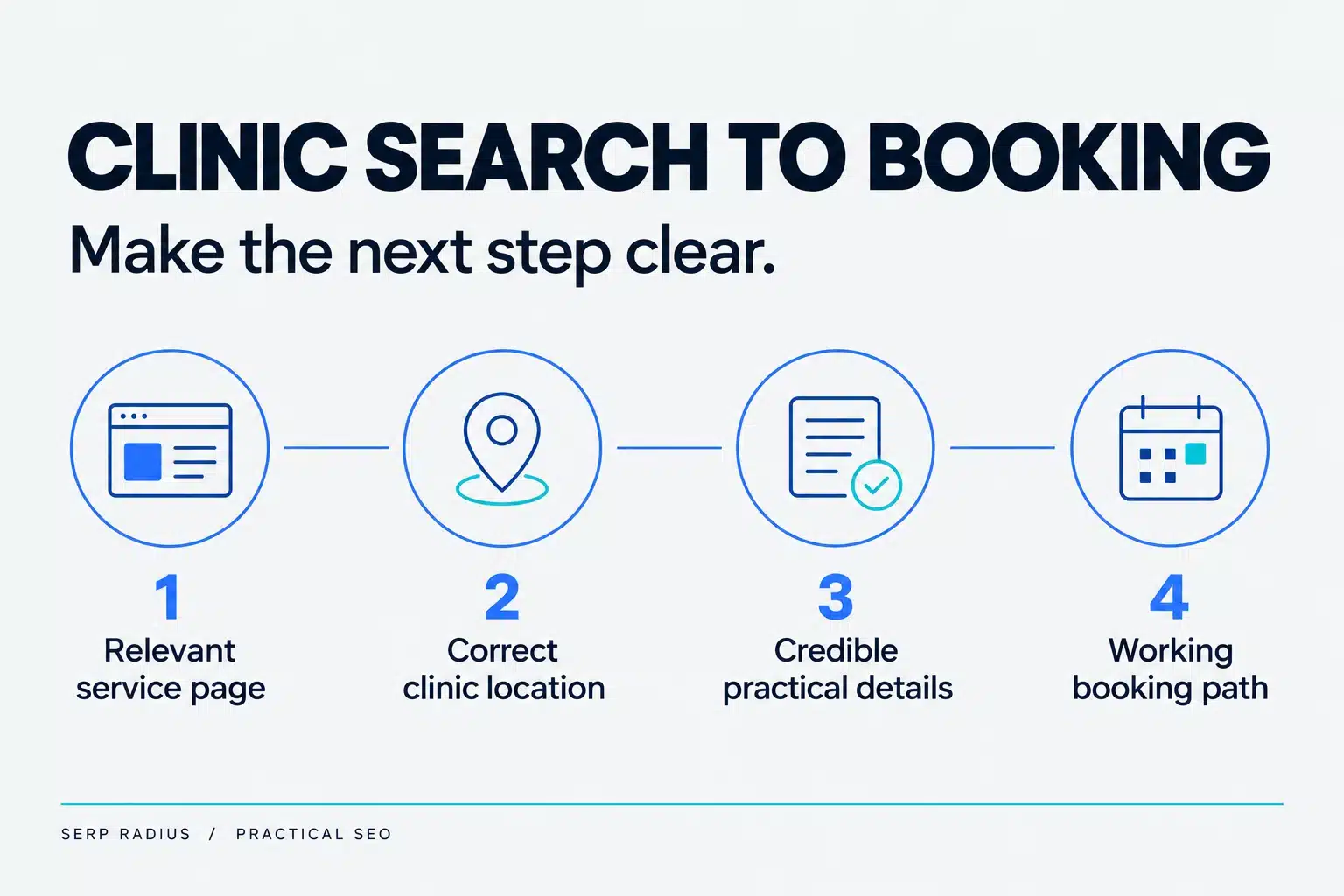
SEO for physiotherapists should connect discovery with a practical patient decision. The person needs to understand the service, identify the right clinic and know how to take the next step.
At SERP Radius, that is the starting point for service-business SEO. We prioritize relevant commercial pages and the enquiry journey before treating a larger publishing calendar as the answer. For a clinic, the useful outcome is an appropriate appointment request, not simply another visit to the website.
Start with the services the clinic wants to grow
Identify which services the clinic actually provides, which locations provide them and where there is capacity for suitable new appointments.
That prevents the content plan from drifting toward topics that attract attention but do not support the operation. A broad exercise article and a service page for an appointment solve different problems.
Ask the clinic team which questions people raise before booking. The useful answers may concern the process, location, availability or what happens at an initial appointment. Use the clinic's approved information rather than inventing details to make the page more persuasive.
Our keyword research approach connects those real needs with search intent and the current results.
Give a genuine service a useful page
A service page should help a visitor establish whether the clinic provides what they are looking for and how to discuss or arrange an appointment.
Use accurate descriptions checked by the appropriate clinician. Explain the practical process and the location where it is available. Avoid unsupported outcome claims or presenting marketing examples as clinical advice.
An illustrative page structure could include the service overview, the clinic's relevant team, what an initial appointment involves and the appropriate booking route. The actual content should follow the clinic's operation.
On-page SEO makes those elements clearer. It does not require repeating a treatment and city in every heading.
Separate clinic information from general education
Educational articles can be useful when they answer real questions and receive appropriate subject-matter review. They should not replace the pages people need to evaluate the clinic itself.
A visitor comparing providers may need to understand location, service availability and the appointment process. A long general article may never answer those questions.
Keep each page's purpose clear. Link educational material to the relevant service when that next step genuinely helps the reader. Do not place an aggressive booking prompt beside content that cannot establish whether the service is appropriate for that individual.
The relationship between explanation and enquiry should feel useful, not forced.
For an expanding clinic, the multiple-location Business Profile checklist connects each branch with its own accurate details and enquiry route. If the clinic is moving, use the address-change checklist instead.
Make the clinic location unmistakable
For a single-location clinic, customers should quickly understand where to go and how to contact the team. For several locations, they should also know which branch provides the service they want.
Compare the Business Profile, location page and booking destination. The same clinic details should be carried through the journey.
An illustrative GTA practice might have one service available at both branches and another at only one. That distinction belongs on the website and in the booking process. It should not be discovered after the patient selects a time.
Our local SEO service considers the connection between local discovery and the page customers reach, rather than reviewing a profile in isolation.
Use trust signals the clinic can substantiate
Show genuine information about the team, the clinic and its working process. Use photographs that represent the actual environment and make professional descriptions accurate.
If a result or testimonial is included, establish that it can be used and that the wording does not imply a guaranteed outcome. A polished page is not a reason to exaggerate what the clinic can promise.
This reflects a wider principle in our content work: specific, supportable information is more useful than interchangeable claims about being the best or most trusted provider.
The clinic's subject-matter review is part of the writing process. SEO research cannot replace it.
Keep review requests genuine
Invite honest feedback through an appropriate process without trying to control the rating. Do not offer a discount or other benefit in return for posting a review.
Google's review policy prohibits incentives and selective positive-review solicitation. That matters because some marketing advice still recommends tactics that conflict with those rules.
Review handling should also respect the context of a clinic. A response should not expose private appointment details merely to make the business's side of a discussion more convincing.
Use reviews as one source of customer trust, not the only explanation for local visibility or the only measure of marketing performance.
Test the route from service page to booking
Open the service page on a phone and follow the next step. Check whether the correct service and location remain clear as the visitor moves into the booking tool or enquiry form.
Then test what happens after the action. Does the team receive the enquiry? Does the confirmation describe the right branch? Is somebody responsible for responding when the visitor cannot book directly?
Ask the booking provider which event establishes a completed request. A visitor opening a calendar has expressed interest; that does not establish that an appointment was booked. Where booking takes place on another domain, include that handoff in the measurement review rather than assuming the website sees the final result.
Document which parts have actually been tested and which still require confirmation.
Measure suitable appointment requests
Review relevant query impressions and visits alongside received enquiries and bookings. Where practical, record the requested service and location without collecting unnecessary personal detail in marketing reports.
If a page attracts visitors but few appropriate requests, investigate the content and booking route. If it brings enquiries for a service the clinic does not offer, investigate the targeting.
Do not assume more traffic will resolve either problem. Our service-business strategy prioritizes lead quality because the value of a visit depends on the business relationship it can support.
For a smaller clinic, a few well-chosen pages may deserve attention before a large library of broad health articles.
Questions clinic owners ask
Should we publish a page for every condition people search for?
No. Start with genuine services and useful patient questions. Clinical claims need appropriate review, and a search phrase alone does not justify another page.
Do separate branches need separate pages?
They often need clear location information. The structure should reflect real differences and make booking easier rather than duplicate the same content with another city name.
Are booking-button clicks enough to measure performance?
They show an interaction. Check whether the booking was completed or an enquiry was received before reporting it as an appointment outcome.
Connect the search to a clear next step
A strong clinic website makes the service understandable, the location obvious and the booking route reliable.
Contact SERP Radius to review the search and enquiry journey for your Canadian physiotherapy clinic. We can identify whether the next priority is visibility, page clarity or the process that turns a visitor into an appointment request.