
A business move changes more than the address on Google Maps. Customers may still find the old location on your website, in a directory, in a booking confirmation or through a saved link.
The useful objective is consistency across the journey. People need to reach the right business, understand where it operates and contact the right team.
At SERP Radius, we approach a move as a coordinated information change. Updating the profile is one task inside that process. It is not the whole local SEO plan, and it does not remove the need to check what customers see after the move.
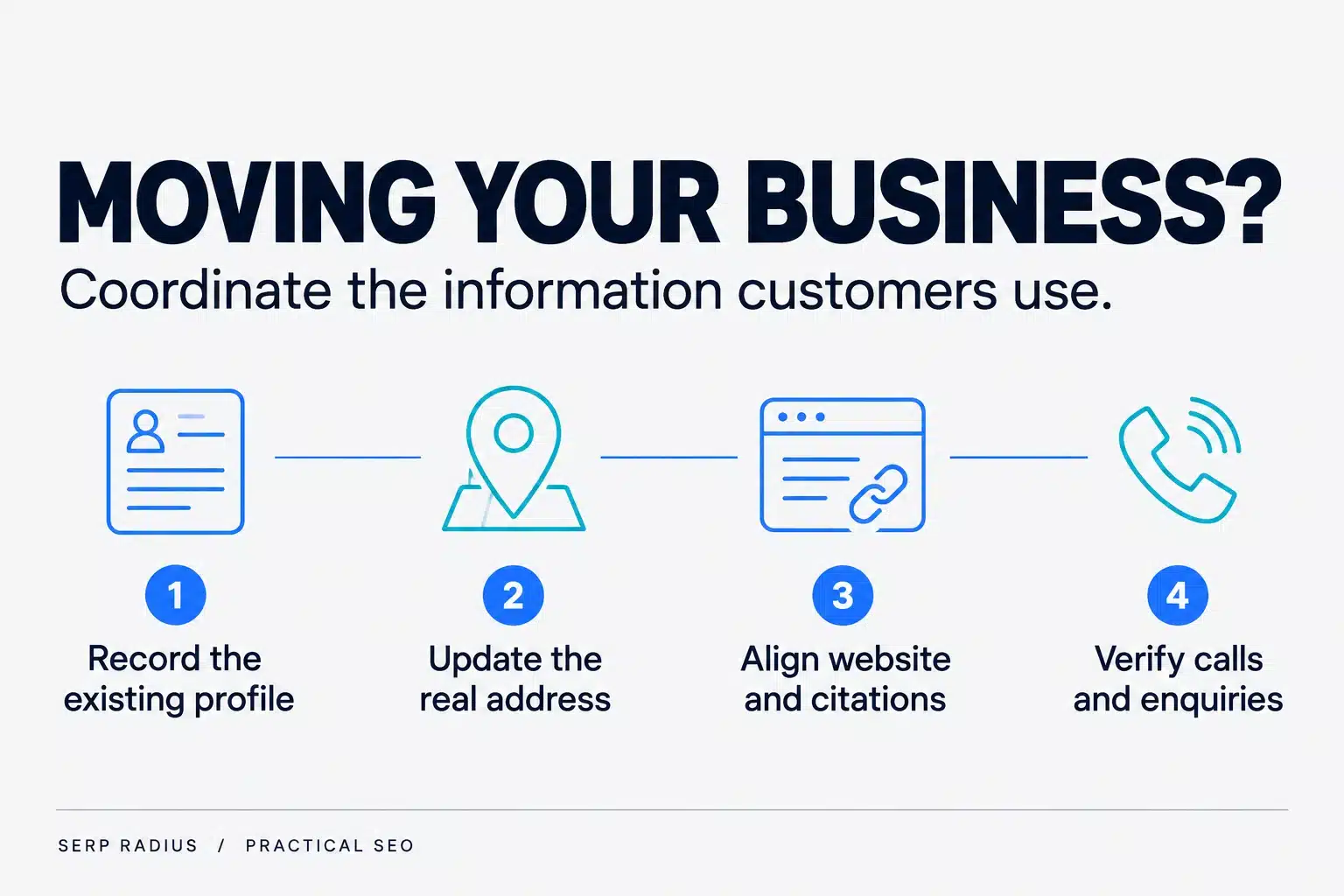
Record the existing setup before changing it
Start with the current Business Profile link, its visible details and the Google account that controls it. Record the website page it links to and the phone number customers use.
Also list the important places where the address appears on your own website. That can include the contact page, footer, service pages, booking tools and structured business information managed by the site.
Keep the record brief enough to use. The point is to know what needs updating and who will handle it, not produce a spreadsheet nobody maintains.
If the move is being managed by several people, assign responsibility before the old and new information become mixed together.
Establish what is actually changing
A relocation, an additional branch and a change to a service-area business are different situations. Do not apply the same process without checking the operation.
An illustrative example is a clinic moving to a new suite while continuing to serve customers in person. That is different from a contractor changing its administrative base while all work remains at customer properties.
Use Google's business address guidance for the profile changes relevant to your arrangement. Check the current instructions and any verification request shown in the account.
Avoid creating another profile by default. Establish whether the existing profile should be updated or whether there is genuinely another eligible operation.
Build a before-and-after move checklist
Use one owner for the overall sequence, even if different people complete individual tasks:
| Stage | What to check |
|---|---|
| Before the move | Access, current profile details, website address locations and important citations |
| At the change | Accurate new information, relevant account prompts and customer communication |
| Immediately afterwards | Public details, map pin, website contact routes and enquiry delivery |
| Follow-up review | Remaining old references, customer confusion and relevant visibility changes |
Choose timing around the real move and the instructions applicable to the profile. Do not make the website promise that customers can visit a location before the business can actually receive them.
For temporary arrangements, explain what the customer needs to know rather than presenting an uncertain opening date as settled.
Align the website with the new location
Update the information on the pages customers use, not just the footer. Check the contact page, location page and any directions, embedded map or booking confirmation.
Open the site on a phone and follow the route a new customer would take. A business can have the correct address in its profile while sending visitors to an old location page. That inconsistency is enough to create confusion without any ranking problem being involved.
Our on-page SEO work includes whether the page makes the service and next step clear. During a move, the location information becomes part of that practical review.
If a URL is changing, plan the appropriate redirect rather than leaving the old page to fail.
Prioritize citations customers are likely to use
List the business directories, industry listings and other references that matter to your actual audience. Start with prominent or frequently used listings and record which ones have been updated.
Do not let a relocation turn into a project to submit the business to every directory you can find. The immediate task is correcting important existing information and making the customer journey reliable.
Our guide to local SEO citations explains the broader role of business details across the web. For the move, keep the scope specific: where is the old information, who controls it and what has been corrected?
Some third-party references will take time or require a separate process. Record that status instead of treating a submission as proof the public listing has changed.
If the listing cannot be found after the move, follow the missing Maps listing diagnostic and record the profile status. If the old premises remain open as a second eligible branch, use the multiple-location checklist to distinguish an expansion from a relocation.
Check the public map and customer-facing details
Once the change is processed, review what an ordinary customer can see. Check the address formatting, map pin and the page reached from the website link.
If the account requests verification or displays a problem, follow that process. Do not repeatedly alter unrelated fields in an attempt to force a particular outcome.
Keep screenshots and the dates of relevant actions. If support is needed, a coherent record makes it easier to describe the issue.
Avoid promising that a move will preserve every ranking or review without interruption. A responsible plan prepares for the change and checks the result; it does not claim control over Google's processing.
Test calls, forms and confirmations
A move can reveal operational gaps that are easy to miss in an SEO checklist. Does the phone reach the right team? Does a booking confirmation include the old address? Do enquiry emails still go to the person responsible?
Check each confirmation for the new location, including any address supplied by a booking provider rather than the website itself. Complete a labelled form submission and have the receiving team confirm delivery. A form animation or button click does not prove the message reached the business.
Test the route customers will actually use and record the result. Where a real call or booking test has not happened, keep that limitation visible.
Monitor the right changes after the move
Review relevant queries, customer actions and enquiry quality over a sensible period. Keep the search location and the service wording in mind when comparing results.
A business in a different physical location may have a different competitive context. Do not assume every movement in visibility is a technical error or that repeating the old setup will recreate the old results.
For local SEO, the useful question is whether the new operation is accurately represented and reaching appropriate customers. That assessment needs more than one search from the owner's phone.
Questions business owners ask
Should I create a new profile when I move?
Do not assume so. Establish whether the existing operation should be updated and follow the process appropriate to the business.
Can an agency guarantee that nothing will change?
No. An agency can coordinate updates, check the result and investigate supported issues. It cannot guarantee unchanged visibility.
Should I fix every old address reference immediately?
Prioritize your own customer-facing information and important third-party listings. Track the remaining work and verify public changes rather than assuming requests are complete.
Make the move understandable to customers
The profile, website and enquiry process should tell the same story about where the business now operates.
If your company is moving within Toronto or the GTA, contact SERP Radius for a local SEO relocation review. We can identify the information and customer routes that need attention before the move becomes a visibility problem.