
A business serves Toronto, Mississauga and Vaughan. Should its website have one service page, three city pages or separate pages for every service in every city?
The answer depends on what those pages would help a customer understand. A larger page count does not automatically create a stronger local website.
At SERP Radius, we start with the service, the search intent and the evidence available. If a separate page cannot offer something useful beyond a different place name, we question whether it should exist. That is a better starting point than building a city-by-service spreadsheet and publishing every combination.
Give a separate page a specific job
A useful service-area page answers a customer question that the regional page cannot answer as clearly. It may explain a genuinely different offer, a particular operating area or relevant work that helps a visitor assess the business.
An illustrative contractor might offer one service throughout Toronto but accept larger projects farther away. That difference can matter to a prospect deciding whether to enquire. Another company may offer exactly the same service and information across adjacent areas, making one clear page sufficient.
The decision should follow the customer task. Do not create a page simply because the location appears in a keyword list.
Check existing pages before adding another URL
List the current service and location pages. Record which searches they are intended to serve and whether they already receive relevant impressions or enquiries.
That step helps distinguish a content gap from a page that needs improvement. A thin regional page may need a better explanation of coverage, stronger evidence or clearer internal links. Adding several thinner city pages would not solve those weaknesses.
Our keyword research process connects search demand to page ownership. One primary customer task should have an obvious destination instead of several pages competing to say the same thing.
Similarity between pages is a reason to investigate. It is not proof that the website is being penalized.
Look for a real difference in the searcher's needs
Review the relevant Google results before deciding on a format. Are people being shown local businesses, regional service pages, guides or directories? Then compare that result with what your business can credibly provide.
If the query is clearly about hiring a provider, the page should explain the service and make an enquiry possible. It should not hide the offer beneath a generic essay about the city.
Likewise, adding neighbourhood landmarks does not make a page locally useful on its own. A customer usually needs to know whether you cover the area, what you can do, why they should trust you and what happens next.
Use local detail when it helps answer those questions.
Make the local evidence meaningful
Useful evidence might include documented work in the area, original project photographs, a genuine customer account or practical information about service delivery. Only include material the business has permission to use.
If you do not have local project evidence, do not invent a story or suggest an office exists nearby. You can still explain real coverage and the service accurately. The absence of a case study may affect how much differentiation the page can provide.
This is why we prefer to establish evidence before writing. A template cannot manufacture the local knowledge that makes a page worth reading.
For the surrounding page elements, see our on-page SEO service.
Use a publish-or-consolidate checklist
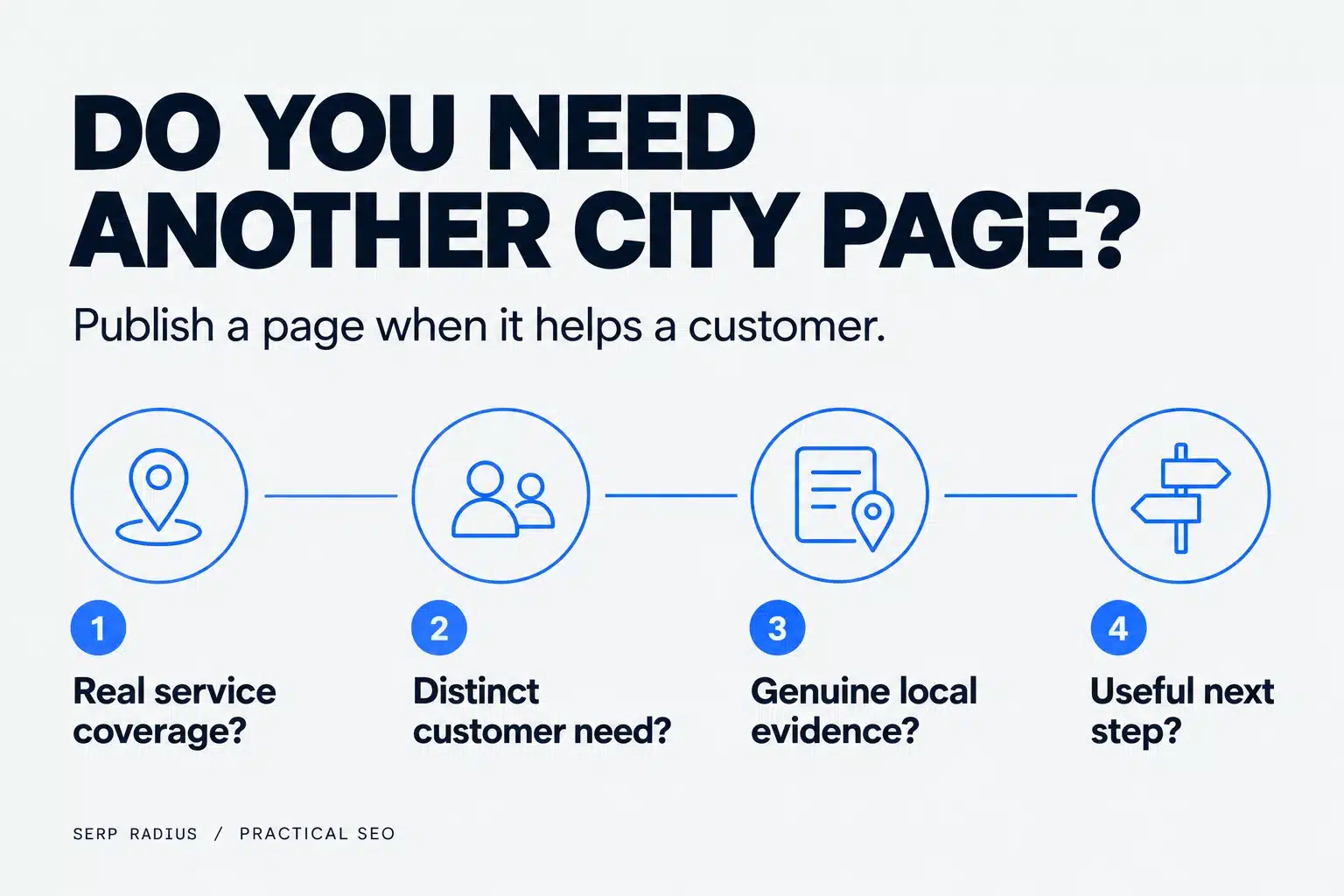
Before approving another page, answer these questions:
| Check | Publish when you can explain this clearly |
|---|---|
| Real coverage | The business genuinely provides the service here |
| Customer need | The page answers a distinct practical question |
| Useful detail | It contains more than a rewritten regional introduction |
| Evidence | Claims can be supported without invented local experience |
| Navigation | Customers can find it through a logical website structure |
| Conversion | The offer and next step match the service |
If the answers are mostly identical across several proposed pages, improve the shared page first. Consolidation can make the site easier to maintain and easier for customers to understand.
Google's spam policies address doorway abuse. The practical editorial standard here is simple: the page should help the visitor, rather than exist only to capture a variation of a search.
Connect pages through a clear structure
Use the regional or service hub to explain the overall offer and link to relevant detail. A city page should connect naturally to the service and to any genuinely useful supporting article.
Avoid a footer containing a long list of nearly identical location links simply because a template allows it. Navigation should reflect the structure customers need.
Our service-business strategy separates commercial pages from supporting content while allowing them to reinforce each other. A troubleshooting article can support a service page without trying to become another service page itself.
The Business Profile service-area guide explains the profile settings for businesses that travel to customers. For a real second office, the multiple-location checklist covers branch details and the page each profile should use.
Keep website pages separate from Business Profile eligibility
A useful city page does not establish a separate branch. A business can explain genuine coverage on its website without claiming an office in each area.
Likewise, changing a profile's service-area settings is not a substitute for improving website content. These are different decisions and should be reviewed separately.
This matters when a company expands. Establish what has changed operationally before choosing whether to add a page, a profile or both. Do not let an SEO template define the business's physical footprint.
Review performance before scaling the template
Start with a small number of defensible pages. Look for relevant query impressions, appropriate visitors and useful enquiries before expanding the same structure across many areas.
If a page attracts impressions for the wrong service, revisit its purpose. If two pages repeatedly answer the same query, compare their intent and evidence before deciding whether they should be combined.
Our duplicate-content guide covers the broader issue. The decision here is whether each location page earns its place through usefulness.
Questions business owners ask
Does every city need unique text?
A separate page needs a useful reason to exist. Changing wording while keeping the same information does not create that reason.
Can I publish pages for places without an office?
You can accurately explain real service coverage. Do not imply a branch or physical presence that the business does not have.
Should weak city pages always be deleted?
No. Review their content, search performance, links and role first. Some need improvement; others may be better consolidated through a planned change.
Build the structure around the customer
The strongest question is not how many pages competitors have. It is what your next page will help a customer decide.
SERP Radius combines local SEO, research and page optimization to answer that question. Request a service-page review before expanding a structure that may need refinement rather than more URLs.