
An AI visibility audit checks whether search systems can access your important pages, whether AI answers describe your business accurately, and whether those answers give people a useful route to your services. Its deliverable should be an evidence-based list of decisions, with an owner and a validation step for each decision.
Begin with one commercial service and a small set of genuine customer questions. A large collection of prompts can hide the basic problem: a service page that never clearly explains who it helps, what the work includes or how to enquire.
Define the business question first
For a Toronto service business, useful questions might concern service availability, provider comparisons and the information needed before requesting a quote. Write these questions without inserting your brand into every prompt. Branded questions test recognition; unbranded questions test discovery within the sample.
Record the search product, exact prompt, language, stated location and whether web search was active. Keep the complete response and its linked sources in your private evidence log. A single answer is an observation, not a reliable market-share estimate.
Separate three findings: the business appeared, a website URL was cited, and the answer recommended the business. Each describes a different outcome.
Check access before rewriting content
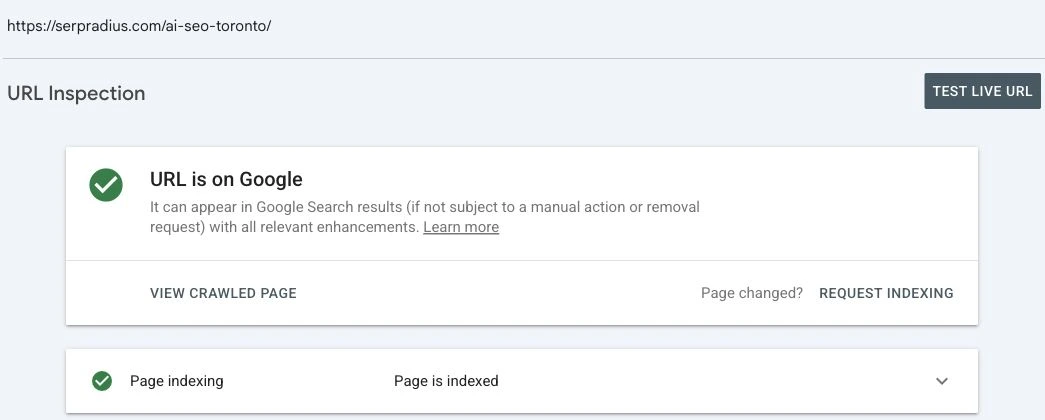
Start with the service page’s live response, visible text, canonical URL and indexing status. Confirm that important information appears without signing in or completing a form. An indexed page can still have weak explanations or inaccurate claims, so indexing is a starting check rather than an audit verdict.
Google’s AI feature guidance explains that supporting pages must be indexed and eligible to show a snippet. Meeting those conditions does not guarantee inclusion.
For ChatGPT search, review crawler controls separately. OpenAI documents its search and training crawlers as distinct controls. Do not change a training preference simply because a search visibility report is weak.
Compare the answer with approved business facts
Build a short fact sheet from the website and information the business has approved. Include actual services, coverage, contact routes and any substantiated qualifications. Do not treat an AI answer as evidence that a business offers something.
Check each sampled response against that sheet. Mark inaccurate descriptions, missing qualifications and unsupported recommendations. Follow the cited URLs: a link to an old directory listing requires a different investigation from a link to your current service page.
Our guide to getting cited in ChatGPT and AI Overviews explains the broader discovery context. The audit should identify the specific information that needs attention on your own website.
Turn observations into a diagnostic worksheet
The following is a hypothetical example, not a client result. Imagine a repair company whose page says only “complete maintenance solutions”. A sampled answer omits the inspection service the company actually provides.
| Finding | Evidence to retain | Next action | Validation |
|---|---|---|---|
| Service explanation is vague | Exact page paragraph | Describe the approved inspection scope | Check the published wording |
| Answer cites an outdated directory | Response and destination URL | Correct the business information where possible | Revisit that listing |
| Enquiry route is unclear | Page and mobile navigation | Add a relevant next step | Test the route |
This worksheet connects a visible issue with a controllable improvement. It does not assume that changing a paragraph will produce a citation.
Prioritise by consequence and confidence
Fix incorrect public business facts and blocked customer journeys before polishing answer-style headings. Next, strengthen explanations that help someone decide whether the service fits their needs. Add original examples or evidence only when you can substantiate them.
Use a simple priority note: what is wrong, who is affected, how certain the diagnosis is and who can fix it. A repeated factual error deserves more attention than one fluctuating recommendation in an isolated answer.
Before commissioning additional articles, check whether an existing page already owns the question. Our explanation of SEO, AEO and GEO helps keep the terminology connected to practical search work.
Before approving a fix, distinguish an observed error from a hypothesis. “The answer uses an old service name” can be demonstrated from the response. “The page needs more authority” needs further investigation. This distinction keeps the work list practical and prevents speculative explanations from becoming expensive implementation requirements. Review the highest-priority findings with the person who can confirm the business facts.
Decide what the audit should deliver
Ask for a page inventory, reproducible observations, factual corrections and a prioritised implementation list. Keep ongoing prompt monitoring and referral reporting as separate follow-up activities.
SERP Radius’s AI SEO services in Toronto can connect those findings with service-page improvements. A useful audit ends with changes you can verify and uncertainties you can explain, rather than an unexplained visibility score.