
Google Local Services Ads connect eligible service businesses with potential customers through a dedicated advertising profile and lead workflow. Canadian availability depends on the business category and area. Check eligibility before budgeting or assuming that a competitor’s setup is available to you.
For an owner evaluating the channel, the practical sequence is eligibility, verification, operational readiness, measurement and then a controlled assessment of lead quality.
What Local Services Ads do
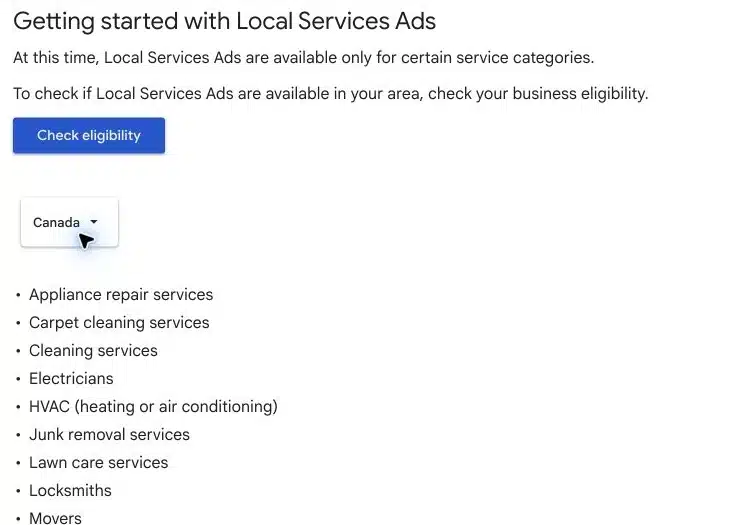
Google’s Canadian getting-started guide describes ads that can connect customers through supported contact options. It lists eligible service categories and directs businesses to the eligibility check for their area.
Local Services Ads are a separate product from a standard Search campaign. A business should not assume that creating one means it has configured the other.
Check Canadian eligibility first
Use Google’s current eligibility process with your actual service and location. The Canadian help page includes categories such as plumbers, electricians, HVAC providers and roofers, but a general list is not confirmation for a particular business.
Then review the Canadian screening and verification requirements applicable to the category. Requirements vary, so collect the documents and business information requested for your situation.
Avoid writing your launch plan around an older badge name or a universal approval timetable. Record the current onboarding status and the requirements still outstanding.
Compare the channel with standard Search Ads and SEO
| Channel | Main planning question | What to measure |
|---|---|---|
| Local Services Ads | Is the business eligible and ready to handle the supported enquiries? | Charged leads, suitability, bookings and clients |
| Standard Search Ads | Does the campaign, destination and conversion setup match the offer? | Spend, relevant visits, enquiries and business outcomes |
| Organic SEO | Which useful pages should serve relevant searches over time? | Search visibility, clicks and attributable enquiries |
Our recommendation is to assess each against the same business objective while respecting its different mechanics. A larger enquiry count can still produce poor economics if few contacts fit the service.
Understand lead costs before setting expectations
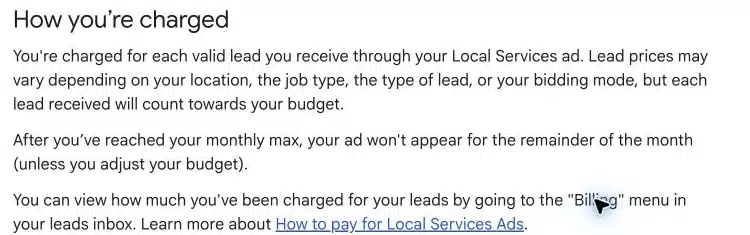
Google’s lead documentation explains valid-lead charging and notes that prices vary with factors such as location, job type, lead type and bidding mode. A charged lead is not a guaranteed booking.
We recommend recording the actual charge and the business outcome separately. Do not build a revenue forecast from a generic cost-per-lead figure found in another market.
A worked example: evaluating a fictional plumbing business
Suppose an eligible plumbing business wants enquiries for a specific service area. Before advertising, it would identify who answers calls, which jobs it accepts, when it has capacity and how enquiries are recorded.
For illustration only, imagine a test produced 12 enquiries, of which 7 matched the service and area, and 3 became booked jobs. Those are different stages. The owner would need spend, revenue and job margin to assess whether the test was worthwhile.
These numbers are hypothetical. They are not SERP Radius campaign results or a prediction for a Canadian plumbing business.
A measurement lesson from our Search Ads preparation
In our standard Search Ads preparation, we reviewed public destination availability, business location assets, form success and conversion definitions. One lesson was that a tag firing did not prove a completed call or a qualified enquiry.
That is adjacent implementation experience, not a Local Services Ads case study. Its useful contribution is the discipline of defining and verifying each stage before judging performance.
Build a lead-quality record you can actually use
For each enquiry, use an appropriate business system to record the requested service, area, response status, suitability, booking outcome and final sale where applicable. Keep personal customer details in the authorized operational system rather than adding them to analytics event parameters.
At review time, ask what drove unsuitable contacts and whether the service profile or operational response needs attention. Consider capacity too: increasing advertising while the business cannot handle new work can create a poor experience.
A launch-readiness checklist
- Confirm category and area eligibility through the current process.
- Complete the required verification and review outstanding conditions.
- Check the advertised services and coverage against what the business actually offers.
- Assign ownership of calls, messages and follow-up.
- Set a budget with the current billing rules understood.
- Record lead quality, bookings and clients separately.
- Choose a review point and assess actual evidence before expanding.
Our SEO versus Google Ads guide covers the broader channel decision. For local organic work, see SERP Radius’s local SEO service.
If you need help deciding how local search and your website should support a lead-generation plan, speak with SERP Radius.