
“Alternate page with proper canonical tag” can be an expected Search Console status. Google recognizes the URL as an alternate of another page, and the canonical points to the version selected for indexing. The important question is whether that selected page is the one your business intends people to find.
Before changing anything, separate a correct exclusion from an incorrect preference. The same report label can have very different implications depending on the URL’s purpose.
What the status means for a business owner
Google’s Page indexing report explains that this alternate is not indexed separately because the canonical page is indexed. That can be appropriate when several URLs represent the same underlying content.
The report is not asking you to make every address independently searchable. It is showing how Google treated that address.

Example one: a tracking variation that should remain an alternate
Consider this illustrative pair:
https://example.com/services/bookkeeping/
https://example.com/services/bookkeeping/?utm_source=newsletter
Assume both display the same bookkeeping service and the tracking variation declares the clean address as canonical. If Google has indexed the intended clean page, an alternate status for the tracking URL may match the desired arrangement.
The business can still use tracking parameters for appropriate campaign attribution. Its organic page does not need a separately indexed copy for every campaign.
Before making changes, verify the actual content, canonical output and inspection details. Parameters can have different purposes; do not assume every parameterized URL is equivalent.
Example two: an important page pointing to the wrong service
Imagine a fictional accounting website with separate bookkeeping and payroll service pages. Someone duplicates the bookkeeping template to create payroll but leaves an explicit canonical pointing to bookkeeping.
The payroll content is intended to serve a different task. In that situation, the technical exclusion may be consistent with the tag while still being wrong for the business.
The review should investigate the canonical setting, template inheritance and other page signals. It should also confirm that the payroll page actually offers distinct information. Changing a tag alone does not make two near-identical pages useful.
A decision table before you touch the settings
| What you find | Recommended next step |
|---|---|
| Correct alternate and correct indexed destination | Record the finding; no automatic fix required |
| Distinct important page points to an unrelated URL | Investigate the declaration and template; correct the intended configuration |
| Several pages seem interchangeable | Review page purpose and consolidation before changing tags |
| Destination cannot be accessed properly | Diagnose the destination response and access first |
| Current output differs from the report | Compare live checks with Google’s last processed information |
Our recommendation is to attach a reason to each action. “Reduce exclusions” is too broad. “Restore the intended canonical for the distinct payroll service” describes a decision that can be verified.
What our page work contributes to the checklist
During SERP Radius’s Mississauga migration, we aligned the new address across its canonical, sitemap and internal links. During city-page schema checks, we also reviewed the rendered output rather than relying only on editor settings.
Those experiences support a practical habit: inspect what the public page actually returns and consider the other components influencing it. They do not establish a client recovery from this exact Search Console status.
How to verify a correction
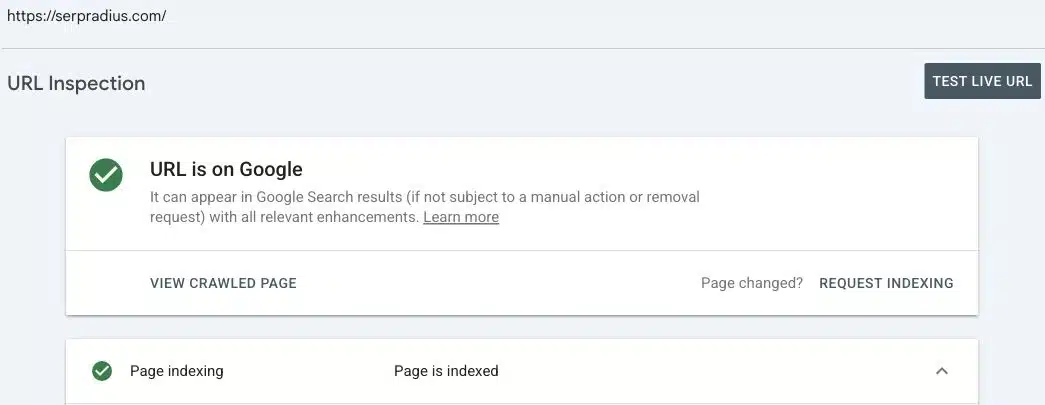
Use Search Console to compare the affected URL and the selected canonical. Google’s URL Inspection documentation explains the difference between indexed data and the current live page. A live test cannot confirm a future canonical decision.
For your own change record, capture the original declaration, the intended replacement, the reason and the current public output. Check internal links and sitemap entries for the page under review.
After Google revisits the URLs, review the processed result. Avoid setting a deadline for reindexing or interpreting a small ranking fluctuation as proof that the correction worked.
Should you remove canonical tags to get more pages indexed?
Do not remove a correct declaration just to reduce the alternate count. Decide which pages deserve an independent search presence and configure them consistently. Google’s canonical consolidation guidance is the reference for those signals.
Our Search Console interpretation guide addresses the wider reporting question. If the preferred page is being crawled but remains excluded under a different status, see the crawled, currently not indexed guide.
For help deciding whether an exclusion is expected or commercially important, contact SERP Radius about a technical review.