
An accounting firm does not need every person searching for financial information to visit its website. It needs the right prospective clients to understand the services it provides and decide whether to enquire.
That changes how SEO for accountants should be planned. A firm seeking ongoing business clients has a different objective from one prioritizing individual tax enquiries. A page that attracts one audience may do very little for the other.
At SERP Radius, we start with the commercial service and the intended client. Search demand matters, but it is useful only when the firm can serve the people behind it.
Choose the client type before the keyword list
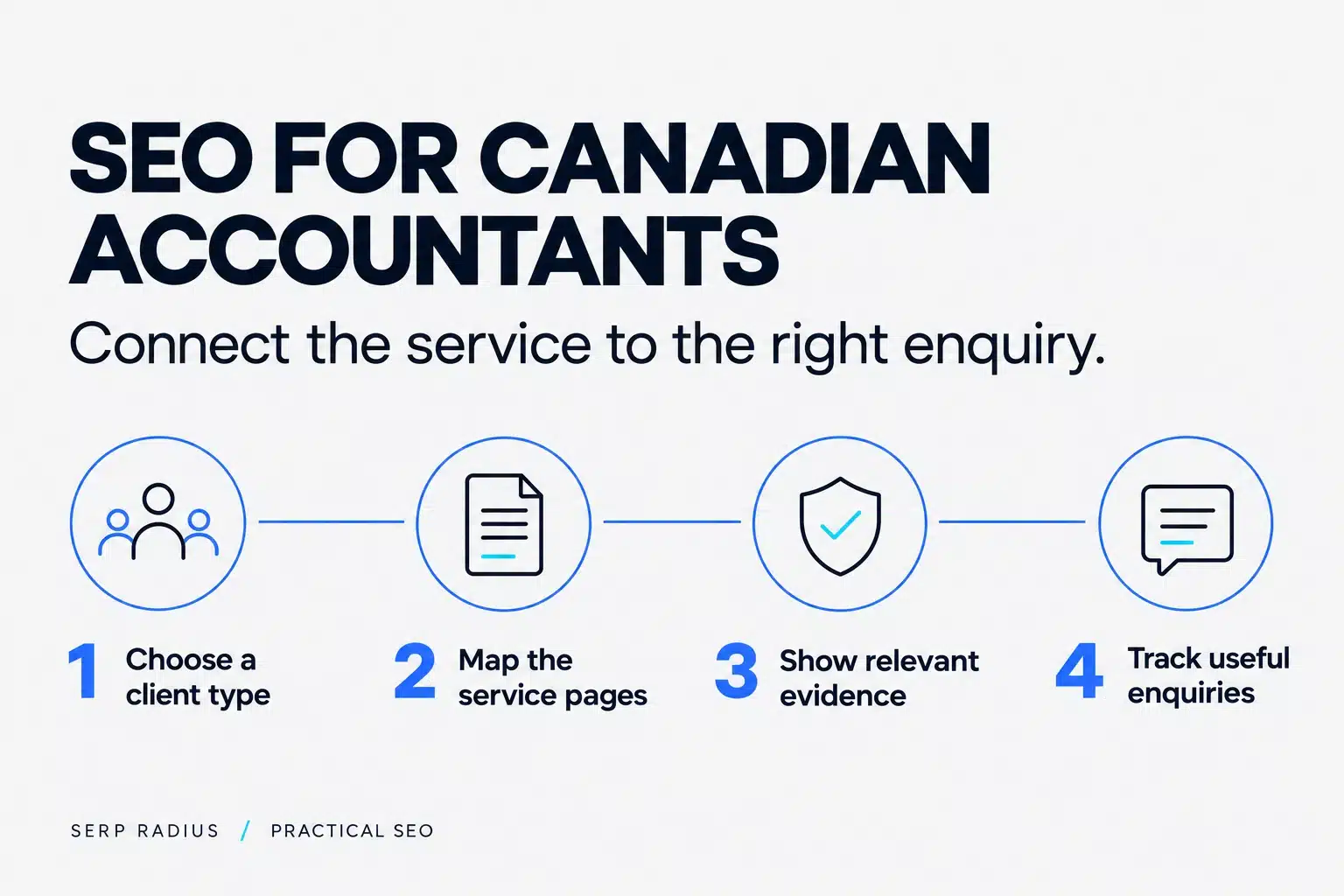
Write down which engagements the firm wants more of and what makes an enquiry suitable. Consider the service required, the type of client and the capacity available to take on work.
This is a planning discussion, not a reason to make the website complicated. The output may be a short list of priority services and a clear definition of the audience for each.
An illustrative example is a firm that wants ongoing bookkeeping and advisory engagements from small companies. A large volume of visits to a general tax explainer would not automatically support that objective.
Our service-business SEO strategy prioritizes business impact, intent, competition and lead quality together. That is the framework to apply before commissioning more content.
Map services to distinct customer needs
List the actual services the firm provides and the questions a prospective client needs answered. Then decide which pages should own those tasks.
For illustration only:
| Service | What the prospective client needs to understand |
|---|---|
| Ongoing bookkeeping | What is handled, how the relationship works and who the service suits |
| Corporate tax support | The scope of assistance and how to discuss the engagement |
| Business advisory | The decisions supported and the experience relevant to them |
These are content-planning examples, not assumptions about every Canadian accounting firm. Use the firm's real services and approved terminology.
If one page tries to explain every offering equally, visitors may struggle to find the detail that matters to their situation.
Research the actual search result
Check whether a proposed query returns firms, software, educational resources or general financial information. That result helps determine whether a service page or an article is the better format.
Then compare the opportunity with the website's current position. An established publisher may dominate a broad informational question, while a specific service page has a more plausible route to relevant enquiries.
Keyword research should produce those decisions, not just a list ordered by volume. Small search demand can still matter when it describes a suitable engagement; large demand can be irrelevant when it attracts the wrong audience.
Keep provider estimates separate from actual enquiry data. They answer different questions.
If the firm wants to serve several markets, use the service-area page checklist before launching a page for every city. A distinct client need and credible coverage matter more than the number of location URLs.
Give each service page enough practical detail
A prospective client should be able to identify the offer, assess whether it fits and understand the next step. Useful content includes the service scope, intended client, working process and information needed for an initial discussion.
Explain the firm's relevant experience using material that can be substantiated. Specific approved examples are more useful than repeated claims about being trusted or results-driven.
Avoid putting confidential client situations into the copy. If an example is hypothetical, label it. If it is real, establish what can be shared before writing it as a case study.
Our on-page SEO service focuses on making the page more relevant and understandable, not simply adding a phrase to more headings.
Connect local visibility to the right page
A firm receiving clients at a location should ensure that its profile, website and contact information describe the same operation. A visitor should not have to work out which office or service the page represents.
Where the firm serves clients remotely across Canada, explain that offer clearly without inventing offices in target cities. A national service relationship and a local branch are different things.
An illustrative Toronto firm might use a location page for office information while maintaining separate pages for its main services. The exact structure depends on what customers need, not on producing every possible service-and-city combination.
Local SEO should support that clarity.
Publish articles that help an owner evaluate the service
Supporting content can answer the questions that arise before an engagement: what information to prepare, how the working relationship is structured or how to assess whether a particular service is appropriate.
Keep the article connected to a relevant commercial page. A useful explanation should make the next step easier rather than leave readers at the end of a general information page.
Do not publish specialist financial guidance simply because it has attractive search volume. Have the appropriate subject-matter professional check any technical claims and keep the firm's actual responsibilities clear.
For an SEO content plan, the primary goal is to help a suitable prospect understand the firm's offer. It does not require an article about every finance question the internet asks.
Make the enquiry form help qualification
Ask for enough information to route the enquiry and decide what conversation is needed. Avoid turning the first contact into a lengthy intake process.
For example, a service-interest field can help separate bookkeeping, tax and advisory requests. The form can invite a brief description of the need without asking the visitor to submit detailed financial records.
Test the form and confirmation process. A visible success message should correspond to an enquiry the team actually receives. Then record whether the contact fits the firm's target work.
That is how the content strategy remains connected to client quality instead of a growing total of anonymous visits.
Review the service-level picture
Look at which pages receive relevant search impressions and which services produce appropriate enquiries. Compare those observations with the firm's commercial priorities.
If a low-priority topic dominates traffic, it may still have some supporting value. It should not automatically receive the largest share of the next month's effort.
If a valuable service page receives little relevant visibility, inspect the query fit, content and competitive context. If visitors arrive but do not contact the firm, examine the offer and enquiry route before publishing another article.
This makes the next decision more specific than “we need more SEO.”
Questions accounting-firm owners ask
Should every service have its own page?
Use separate pages where the service and customer task are genuinely distinct. Avoid splitting a small amount of identical information across several URLs.
Should a Canadian firm target only Toronto keywords?
That depends on where it operates and the relationships it can serve. Local and Canada-wide targeting should reflect the real offer.
Is traffic the best measure of the strategy?
Traffic helps explain discovery. Appropriate enquiries and the work they become are closer to the firm's business objective.
Build around the engagements you want
Start with the right client, give the service a useful page and make the enquiry route clear. Then use search and sales evidence to decide what to improve.
Contact SERP Radius for a review of your accounting firm's search opportunities, service pages and enquiry path. The aim is to attract work that fits the firm, not simply increase visits.