
A contractor can work across the GTA without having an office in every city. The challenge is describing that coverage accurately while giving customers a clear picture of where the business operates.
Google Business Profile service areas help communicate coverage. They are not a way to purchase visibility or prove that a business will rank throughout every selected city.
At SERP Radius, we separate the operational question from the SEO question. First establish where the business genuinely works and how customers receive the service. Then investigate where it is visible and what the website needs to support those searches.
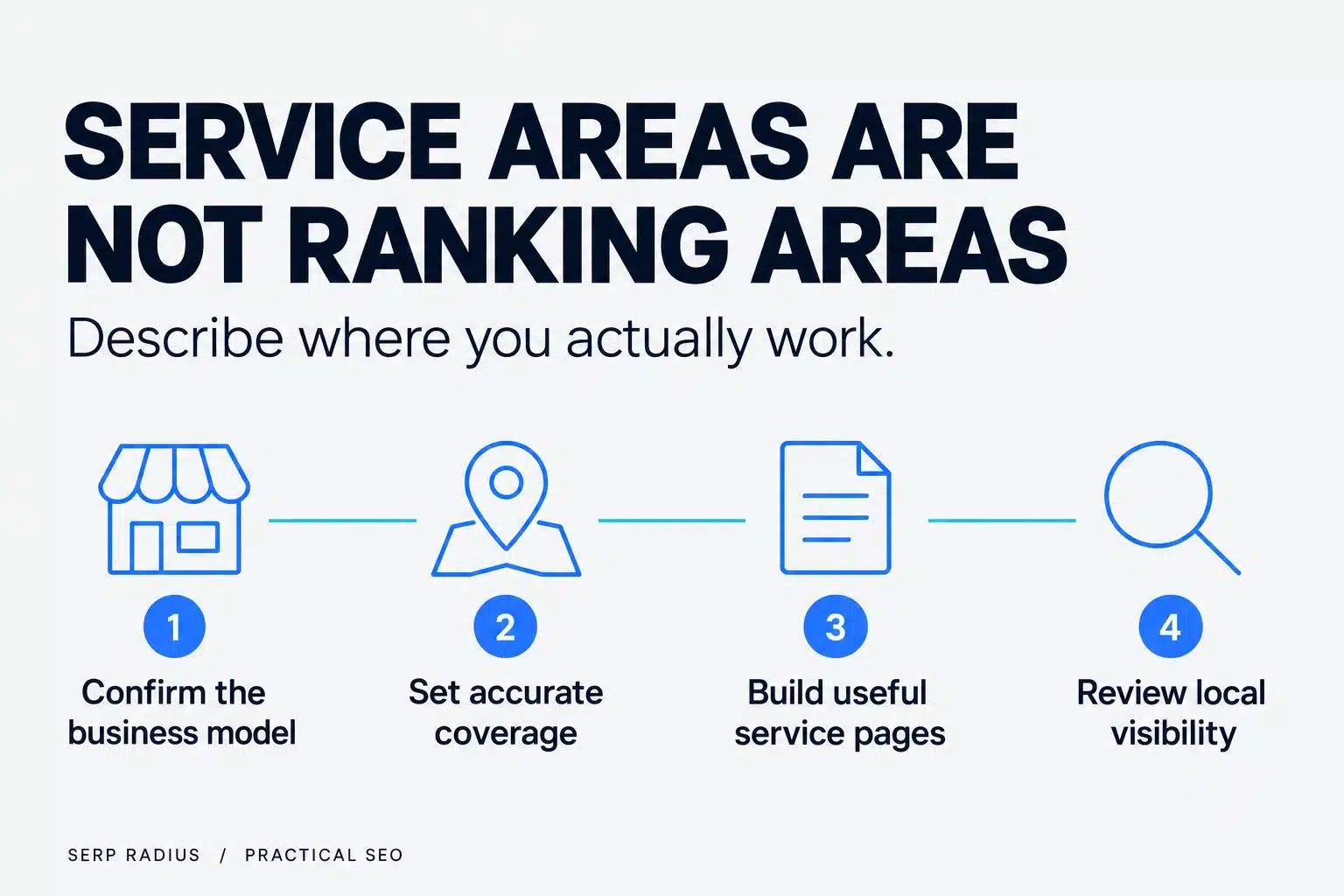
Establish the business model first
Does the business visit customers, receive customers at a staffed location, or do both? That distinction matters before choosing what information to display.
An illustrative example is a plumber who operates from a home base and performs all customer work on site. That is different from a business with a showroom customers can visit during stated hours. A company with both arrangements needs to represent both accurately.
Google's business representation guidelines describe the eligibility and address requirements for different business models. Check the applicable rules before setting up or changing a profile.
Do not start with the assumption that showing an address is always better, or that every business should hide one. Start with the real operation.
Describe coverage you can actually deliver
Write down where you regularly accept work and whether the service differs across that area. Include practical constraints such as travel time, job size and the availability of urgent appointments.
For example, a contractor may accept planned projects throughout the GTA but offer short-notice work only closer to its base. The website should make that distinction understandable instead of promising the same response everywhere.
That is a customer communication decision as much as an SEO decision. A visitor who needs immediate help should not have to discover the limit after completing a form.
Avoid adding cities solely because they appear attractive in a keyword tool. Demand has business value only when the company can serve it properly.
Check the actual service-area settings
In the current Business Profile workflow, open Edit profile, choose Location and review Service area. Select the areas the business actually serves, then save the change. Google supports named areas such as cities and postal codes rather than a custom radius.
Google currently allows up to 20 service areas and says overall coverage should generally remain within about two hours of driving from the business base. Those are profile guidelines, not a suggestion to select the maximum. Follow the current service-area instructions and any account-specific prompts when making the change.
Keep profile settings separate from ranking expectations
Adding a service area describes coverage. It does not establish where Google will display the business for a competitive search.
In our local SEO work, the next step is to compare visibility for the services and locations that matter. Record the search phrase and the place used for the check. A broad Toronto query and a neighbourhood query can produce different results.
An illustrative contractor could receive work in Vaughan while appearing inconsistently for a competitive search there. That observation calls for a visibility review, not an automatic conclusion that the service-area settings are broken.
Keep the question specific: are customers unable to find the profile, or is it present but not competitive for the service query?
Review the page customers land on
A profile can accurately describe coverage while linking to a page that leaves customers uncertain. Open the destination on a phone and check three things: the service, the area covered and the next step.
For a small company, one clear regional page may be enough. A larger operation may need separate service pages or genuinely useful location pages. The structure should reflect differences customers need to understand.
Our service-business SEO approach gives commercial pages priority because they carry the offer. More content is not helpful if the main service page remains vague.
Do not assume a city-specific URL is a better destination without reading the page itself.
Use a coverage worksheet before expanding the website
Put the operational and content decisions in one place:
| Question | What a useful answer contains |
|---|---|
| Which service is available? | A specific service the team actually provides |
| Where is it available? | Real operating coverage |
| What differs by area? | Availability, project type or other customer-relevant details |
| What evidence exists? | Relevant work, photographs or genuine customer feedback |
| Where should visitors go? | The page and enquiry route that fit the service |
This is a planning tool, not a requirement to create a page for every row. If several areas share the same offer and the same useful information, consolidation may be the clearer choice.
Website coverage also needs a separate decision. Use the service-area page checklist before creating city pages. If the business is opening a genuine branch, follow the multiple-location profile checklist instead of treating it as another service-area setting.
Do not confuse service areas with additional branches
Serving another city does not automatically make it a separate business location. A genuine branch brings operational questions about staff, access, customer contact and the website page representing it.
Do not create a second profile simply to reach more searchers. Review the actual location and Google's requirements before deciding whether another profile is appropriate.
Likewise, a mailing address should not be presented as an operating branch just because it is inside a target city. A defensible local presence starts with how the business operates, not how many city names can be added to an account.
This distinction also prevents the website from implying there is a local office where none exists.
Measure enquiry quality by service and area
Once coverage is clear, evaluate whether it attracts the work the business wants. Track received enquiries and record the requested service and location when that information is useful.
Review the difference between where enquiries originate and where the business can accept work. A contractor needs to know whether a contact became a suitable job opportunity, not just whether somebody clicked. A simple monthly review can group received enquiries by requested service, area and fit.
If enquiries arrive from places the company does not serve, inspect the wording and targeting. If relevant visitors arrive but do not enquire, review trust, availability and the contact process before assuming another keyword is the answer.
Review coverage when the operation changes
Revisit the profile and website when the team expands, a service changes or a branch opens. Keep a record of what changed and why.
There is no value in leaving outdated coverage visible because it was once part of an SEO plan. Equally, do not repeatedly alter coverage in response to a single disappointing search result. Use consistent observations and actual operational changes to guide the review.
Questions contractors ask
Will adding more cities improve my rankings?
Do not rely on that assumption. Describe real coverage and assess competitive visibility separately.
Do I need a website page for every service area?
No. Create separate pages when they give customers distinct, useful information. Avoid pages that only swap the city name.
Can I use a virtual address to reach another market?
Do not use an address to imply an operation that does not exist. Check Google's current eligibility requirements for the actual arrangement.
Start with the real service footprint
Accurate coverage, relevant pages and useful enquiry data give you a better basis for local SEO decisions than an ever-growing list of cities.
SERP Radius helps GTA service businesses connect those pieces. Request a consultation to review your profile, website structure and the areas where you can realistically compete.