
If you’ve hired an SEO agency or done any research into local search, you’ve probably heard the word “citations” thrown around. Most explanations make it sound either too simple or too technical.
Here’s the plain version.
What a Citation Actually Is
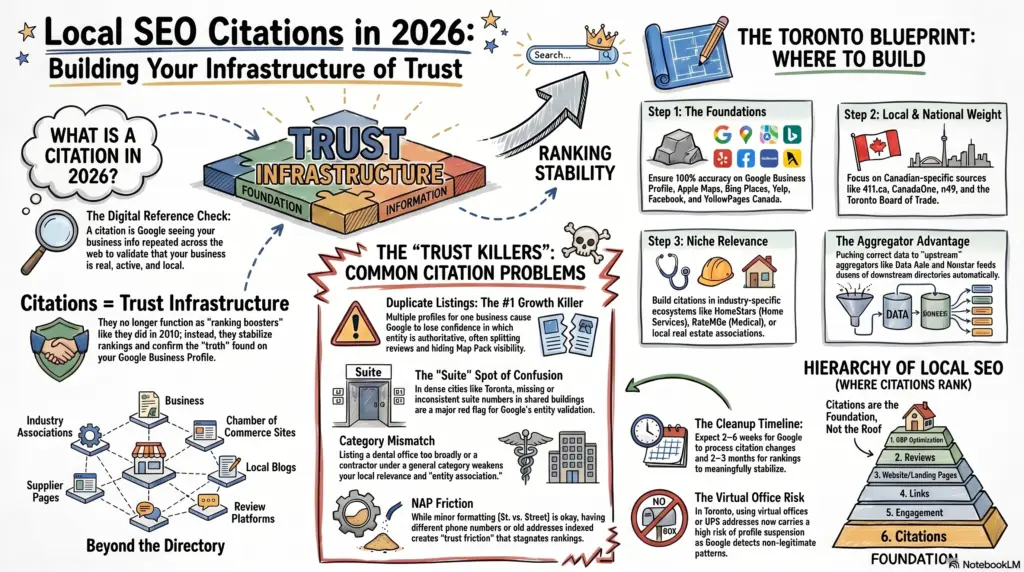
A citation is Google seeing your business information repeated across the internet and using that repetition as trust validation.
Think of it like a reference check. Every time your business name, phone number, and address appear on another website, it tells Google that your business is real, active, local, and consistently represented online. Your Google Business Profile is your primary source of truth. Citations are what confirm that story across the rest of the web.
And it’s not just directories anymore. Citations exist on business directories, industry associations, chamber of commerce websites, local sponsorship pages, maps platforms, review platforms, supplier pages, local blogs, and trade directories. For local SEO, citations help Google connect who you are, what you do, where you operate, and whether your business information can be trusted.
Do Citations Still Matter in 2026?
Yes, but not the way they did ten years ago.
In the mid-2010s, agencies were blasting thousands of directory submissions and seeing ranking movement. That era is finished. In 2026, citations function more like trust infrastructure than ranking boosters.
What I’ve seen across local campaigns in Toronto is consistent: strong citations help stabilize rankings, weak or inconsistent citations create trust friction, and citation cleanup often helps businesses recover from ranking stagnation that nothing else seems to fix. But bulk citation spam, low-quality international directories, and automated directory blasts do nothing. Google has become significantly better at entity validation. It cross-checks your GBP data, website content, reviews, user behaviour, brand mentions, and citation consistency all together.
Citations alone will not rank a Toronto business. But broken citations absolutely hold businesses back. That distinction matters more than most agencies admit.
The Most Damaging Citation Problem
Duplicate listings. By far.
This is especially common in Toronto because businesses move offices, change suites, rebrand, merge locations, or use coworking spaces. When duplicate listings exist, Google doesn’t know which profile is authoritative. The symptoms are hard to diagnose because they look like a rankings problem rather than a citations problem.
I’ve seen cases where reviews split across multiple profiles, map pack visibility disappeared intermittently, wrong phone numbers got indexed in search results, and old addresses continued ranking for the business name. Inconsistent NAP is usually recoverable. Duplicate entities are much more damaging and take longer to clean up.
The second most damaging issue is category mismatch. A dental office categorized too broadly or a contractor listed under a general category weakens local relevance in the same way a wrong GBP primary category does. We cover how category selection affects Google Business Profile performance in more detail separately.
Where to Actually Build Citations for Toronto Businesses
Most citation lists you find online are outdated. For Toronto businesses in 2026, the directories that still matter are the ones Google actually trusts and crawls consistently.
The foundational platforms every Toronto business should be on are Google Business Profile, Apple Maps, Bing Places, Yelp, Facebook, YellowPages Canada, Better Business Bureau, and Foursquare.
Beyond that, Canadian and Toronto-specific sources carry more local weight than generic directories. These include 411.ca, CanadaOne, n49, the Toronto Board of Trade, local chamber of commerce websites, and industry associations relevant to your sector.
For industry-specific citations, the directories that matter are:
Home services: HomeStars, TrustedPros, Houzz, and local supplier directories. Dental practices: RateMDs and Opencare. Medical clinics: provincial registries and health-related provider directories. Real estate: the realtor ecosystem, brokerage profiles, and local real estate associations.
These niche citations help reinforce topical relevance and entity association. Google increasingly understands industry ecosystems, and a citation from a relevant industry directory carries more weight than fifty submissions to generic SEO directories.
One layer most Toronto businesses never think about is data aggregators. Platforms like Data Axle and Neustar sit upstream from dozens of directories and map providers. When your business information is correct at the aggregator level, it feeds downstream platforms automatically, including GPS providers and the Apple ecosystem. This matters because Google cross-references these data sources when validating entity information. Getting your data right at the aggregator level is more efficient than manually fixing fifty individual directories, and the consistency signal it creates is stronger.
What is mostly a waste of time now: generic low-authority SEO directories, foreign directories unrelated to Canada, massive automated submissions, and citation sites built purely for link builders.
How Strict Does NAP Consistency Actually Need to Be?
SEO agencies often overstate this. Google is smarter than exact-match string comparisons now. “Street” vs “St.” is usually not a problem. Minor formatting variations are rarely the issue.
The real problems are different phone numbers appearing across listings, different versions of your business name, call tracking numbers replacing your primary number, old addresses that were never cleaned up, and missing suite numbers in shared buildings.
Suite numbers matter more in Toronto than most cities because of the density of shared commercial buildings and coworking spaces. Google uses suite data to distinguish entities in dense urban areas, so a missing or inconsistent suite number can cause more confusion than you’d expect.
The business name consistency issue is also more common than people realize. If your business appears as four different variations across citations, Google has a harder time building a confident entity understanding.
A Real Before and After
A local service business in the GTA came to us with rankings that fluctuated constantly, map visibility that disappeared intermittently, and branded searches that were triggering the wrong profile.
When we dug in, the picture was clear: two old addresses still indexed, three duplicate GBP listings, inconsistent phone numbers across directories, and citations from a previous agency pointing to dead URLs. Reviews had fragmented across profiles, which meant the business looked weaker than it actually was.
What we fixed: consolidated the duplicate listings, standardized NAP across all platforms, removed legacy citations, rebuilt foundational citations correctly, corrected categories, and aligned website schema with the GBP.
The timeline: branded visibility stabilized around week three. Map pack impressions increased by week five. Consistent local keyword movement started around month two.
The important part is that citation cleanup alone did not create rankings. It removed the trust confusion that was suppressing performance. Once the foundation stabilized, the GBP optimization and on-page SEO work that was already in place started performing the way it should have been.
How Long Does Citation Cleanup Take to Show Results?
Usually two to six weeks for Google to process changes and two to three months for meaningful stabilization.
Google doesn’t refresh every citation source immediately. Some directories update quickly. Some take months. Some never update unless manually pushed. Duplicate suppression takes additional time because Google has to reprocess entity relationships, not just update a listing.
The faster results typically happen when duplicate GBPs are removed first, major inconsistencies in high-authority directories are corrected early, and the GBP itself is already well-optimized. Citation cleanup works faster when it’s not the only thing being fixed. For context on how citation timelines fit into the broader SEO timeline, our guide on how long SEO takes in Toronto breaks down what to expect at each stage.
Where Citations Rank Against Other Local SEO Signals
If I had to prioritize local SEO for a Toronto business today, the order would look like this: GBP optimization first, then reviews and review velocity, then website quality and local landing pages, then internal linking and link building for local relevance, then behavioural signals and engagement, and then citations and entity consistency.
Citations are foundational, not primary growth levers. If a business has poor GBP optimization, weak reviews, thin content, and bad location pages, building citations first is the wrong move. The infrastructure has to be there first. Citations amplify a working system. They do not fix a broken one. That distinction is what separates agencies that get results from ones that keep sending citation reports while rankings don’t move.
But if the business already has decent SEO infrastructure, citation cleanup becomes important because it improves trust consistency across Google’s local ecosystem. It’s the difference between a system that’s working cleanly versus one that’s working against itself. Our local SEO services address citations as part of a full audit rather than as a standalone tactic for exactly this reason.
The One Citation Mistake Toronto Businesses Make That Nobody Warns Them About
Changing tracking numbers constantly.
A lot of agencies inject call tracking numbers across every platform, rotate numbers, and replace the primary business number inconsistently. Over time Google starts seeing four phone numbers, three business name variations, multiple landing pages, and conflicting references. The result is entity confusion that looks like a rankings problem but is actually a data consistency problem.
Call tracking is fine when implemented correctly. The primary business number should stay canonical across GBP, your website schema, and all major citations. Tracking numbers should be secondary and handled in a way that doesn’t overwrite your primary contact information.
The other Toronto-specific issue that deserves its own mention is virtual offices and UPS addresses. A lot of businesses use these to establish a presence in a neighbourhood or postal code they don’t actually operate from. Google has become significantly more aggressive about filtering these in dense urban markets like Toronto. The algorithm is better at detecting address patterns that don’t match legitimate business operations, and when it flags a profile, the ranking collapse is fast. Recovering from a filtered or suspended profile takes considerably longer than building a clean one from the start. If you’re using a virtual office for local SEO purposes, the risk now outweighs the benefit in most Toronto markets.
If you’re unsure whether your citation profile is working for or against your local rankings, that’s exactly the kind of thing a technical SEO audit surfaces. It’s usually one of the first things we check when a Toronto business has rankings that won’t stabilize regardless of what else is being done.
If you want to know where your citations stand, get in touch and we can take a look.